How F&B Automation Keeps You Competitive

Outdated food & beverage plants risk costly bottlenecks, worker injuries, and inefficiency. Explore how automation, like robotics and vacuum lifters, help operations improve safety, consistency, and competitiveness.
Food and beverage (F&B) facilities have tight margins. This means having efficient processes is crucial for staying competitive.
But manual lifting or outdated machinery can cause bottlenecks that hurt your business. Discover economic and safety costs to monitor and explore solutions that can add consistency and efficiency to your operations.
This article will address:
- The cost of having an outdated F&B plant
- How F&B plants can stay competitive
- How F&B automation improves processes
- How TAWI can help F&B operations
What is the Cost of Having an Outdated Food and Beverage Plant?
When you hear “cost,” money is probably the first thing that comes to mind. Inefficient plant operations can certainly increase financial costs. But they can also have a negative impact on workers’ health and safety.
Let’s look at the hidden costs of keeping processes the same simply because “that’s how they’ve always been done.”
Economic Concerns
Many food and beverage facilities are using machines and automation for their operations. So, it becomes a matter of efficiency. As the old saying goes, "time is money."
Outdated machinery might get the job done, but it might work slower than other options on the market. Operations also face the chance of costly repairs and a long wait time for parts.
Some companies still rely on manual handling for parts of their process, like the start or end. However, human strength can be unreliable.
People can suffer from fatigue or injuries, and that will slow them down. Slowdowns and insurance payouts are expensive for businesses.
You should evaluate areas with outdated machinery and manual lifting.
Safety Concerns
Manually lifting items, even lighter items, takes a physical toll. For example, operations don't just need one bag to be lifted. Workers need to handle an entire stack of bags, which leads to repetitive lifting and strain.
That repetitive lifting has an impact:
- Physical strain on back, shoulders, wrists
- Risk of injuries
- Bending over & other postures that don’t support ergonomics
- Fatigue
When workers get injured, they need time to recover. That makes operations short-staffed and puts more strain on other workers. That can lead to more injuries, disrupt production even more, and hurt employee morale.
Having experienced workers is valuable. Creating a safe work environment can improve staff retention, so workers stay and their knowledge of production stays too.
How can F&B Plants Stay Competitive?
Food and beverage plants need to make sure that their processes are efficient, and their tools prepare them to be successful in future. Times change quickly, but strong workflows can help operations be resilient.
Efficiency & Ergonomics
Workers are a critical part of the process. Having injured workers, short-staffed operations, and lots of turnover hurts efficiency.
Many companies are also struggling to find workers. This makes the market more competitive to hire and keep staff. This means having good ergonomics is also good for efficiency.
Staying Adaptable
Facilities can react to manufacturing changes more quickly if they use adaptable equipment. This means using equipment that is flexible enough to work in different areas and/or handle different processes.
Some equipment is fixed in place, or it is so specific that it has one narrow purpose. They work well when they are first used, but what if your process changes?
Your operations can make a long-term investment with equipment that can make changes when you need them.
Choosing the Right Tool for the Job
When an item needs to be lifted, operations need to consider what tool will be best for the job.
Manual lifting doesn't require expensive equipment, but it can increase the risk of worker injuries. It may work for occasional lifting, but it is usually not a sustainable option for frequent lifting tasks.
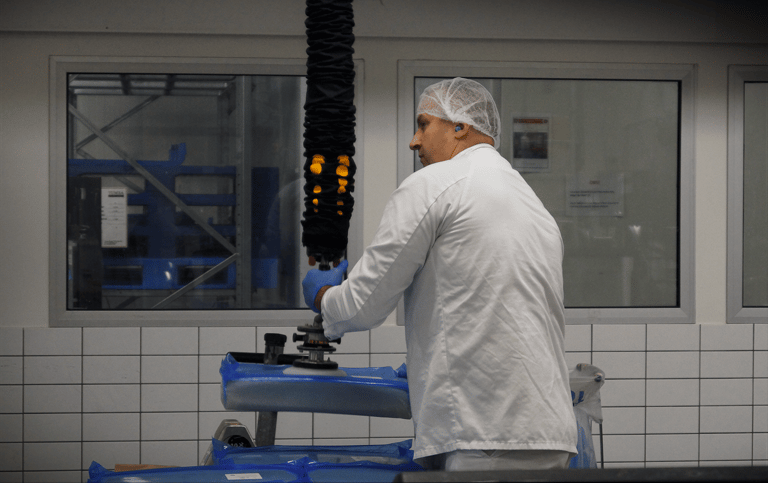
Automation reduces the physical strain on workers and supports smooth, consistent processes. There are fully automated systems, such as robots, and semi-automated systems, such as vacuum lifters.
How can F&B Automation Improve Processes?
Both types of automation (fully and semi-automated) play an important role in effective material handling.
They reduce manual handling and the chance of injuries that come with it. This makes lifting tasks safer for workers.
Also, they improve product integrity. They reduce direct contact that workers have with the food and decrease the chance of dropping an item.
Benefits of fully automation solutions
- Repeat the same motion over and over again with high precision
- Maintain production when staffing is very limited
- Produce useful data to track line performance
Benefits of semi-automated solutions
- Improve productivity (useful when products vary, limited floor space, frequent changeovers, etc.)
- Combine human expertise with equipment that handles the weight of the load
- Support flexible operations (can be adapted to handle different loads, packaging types, and workstations)
The best solution depends on the specific situation. But operations can use both in their workflow because manufacturing has many different lifting tasks.

How can TAWI Help F&B Operations?
TAWI offers semi-automated lifting solutions to lift many different types of items in food and beverage manufacturing. Also, we have an aftermarket support team that supports customers after the sales with spare parts, repair visits, maintenance visits, and more.
Examples of tasks to semi-automate
- Lifting ingredient bags into mixers, hoppers, or batch stations
- Handling cartons and cases at packing, palletizing, or rework stations
- Moving drums, pails, and buckets to the right station and tilting/dumping them as needed
- Loading and unloading boxes, bags, and other packaged goods on pallets
- Assisting operators in cold rooms where manual lifting is more difficult and there is a greater risk of fatigue
Value of Adding a TAWI Solution
With the power of vacuum lifter or lifting trolley, one operator can safely handle lifting tasks.
Operators can work at a consistent speed throughout their shift when they have a tool that handles the weight of the load. This improves the efficiency of lifting tasks and helps remove the bottlenecks that manual lifting can cause.
Also, operations can select a fixed vacuum solution (when they need to cover lifting in one area) or a mobile solution. Mobile solutions can handle lifting across a facility and adapt to changes in workflow quickly.
- Lifting trolley- well-suited to lift, lower, move, and tilt items like reels and drums
- Mobile vacuum lifters- support moving items like bags, boxes, and more for palletising, order picking, and container unloading tasks
Next Steps
Learn more by reading our guide, "A Plant Manager's Recipe for Efficiency in Food Manufacturing Equipment."
Have any questions about lifting solutions or which one can help your operations? Contact TAWI, and a lifting expert will be happy to discuss your specific application.